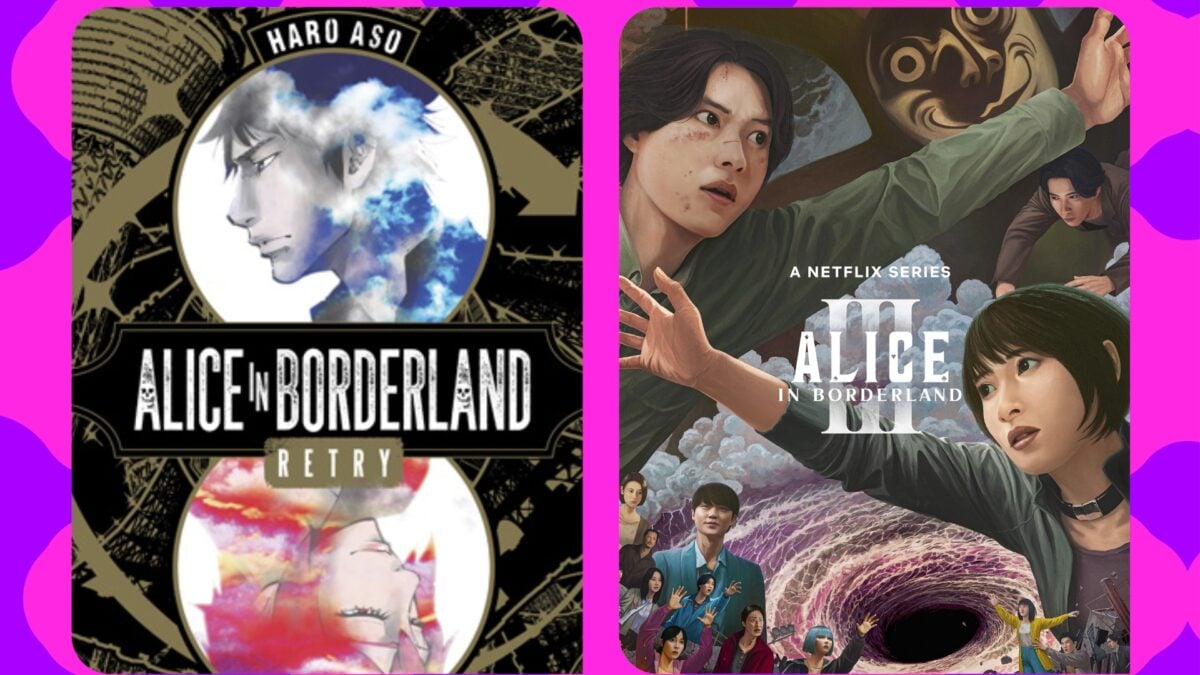
When the eighth and final season of Game of Thrones wrapped up, I—discovering the series entirely through the TV adaptation—naively figured George R.R. Martin could simply pen a different ending to salvage the fanbase’s lost goodwill. Little did I realize that this remains a remarkably sensitive topic among book readers who have endured the author’s legendary procrastination for years. My sympathies.
While the trajectory isn’t an exact parallel to what happened with Netflix’s live-action Alice in Borderland and VIZ Media’s English release of the franchise’s extended epilogue, Alice in Borderland: Retry, the manga acts as a welcome palate cleanser. It more than retroactively heals the disappointment I felt watching a beloved adaptation lean into a Squid Game-style formula during its final stretch.
Alice in Borderland is a sharp thriller following a man named Arisu, who finds himself trapped in a sci-fi death game where stranded survivors must compete in brutal challenges across an abandoned city. Think of it as Gantz meeting Kaiji. The rules are ruthless, yet they always make internal logical sense; players must genuinely outsmart one another to survive, or face swift execution via a descending laser.
The show was so compelling I initially didn’t even realize it was based on a manga by Haro Aso (creator of Zom 100: Bucketlist of the Dead), which also received an anime adaptation. That pedigree alone made it stand out in a sea of otherwise underwhelming live-action Netflix projects. For two seasons, it captured the zeitgeist—arriving right before the global Squid Game phenomenon and riding its coattails. That is, until a third season debuted last year, dragging Arisu and his partner Usagi out of their peaceful, post-game life and thrusting them back into the nightmare.
I was willing to go along with the new season for a while, despite its improvised feel, until it crossed a line and mimicked the cheap tactics of Squid Game’s final moments. It desperately forced a sequel hook into a stinger, asking a question nobody was actually wondering: What if this happened in America? Here’s hoping that premise never sees the light of day, especially given how thoroughly it dragged down the original show’s reputation. As far as I’m concerned, that third season never happened.
Alice in Borderland Retry is now available in print and digital!
Read a free preview: https://t.co/OJcjm9wliH pic.twitter.com/8iqGzwjTIV
— VIZ Media (@VIZMedia) July 21, 2026
So imagine my relief upon discovering VIZ Media’s localized release of Aso’s 2020 epilogue manga—set a decade after the original conclusion—which serves as the exact antidote I needed to flush the Netflix finale from my memory. The manga kicks off with a similar premise to the TV show’s third season (naturally, since the manga came first): Arisu has transitioned from a NEET to a psychologist, and Usagi is expecting their first child. From there, however, the similarities vanish entirely.
Unlike the contrived plotting the Netflix series relies on to drag everyone back into the arena, Arisu ends up back in the Borderlands via a far simpler catalyst. He and five others are struck by a falling billboard, waking up in the desolate realm. While this inciting incident lacks the massive scale of his original arrival, what it lacks in spectacle it makes up for in the sheer precision of the upcoming challenge.
Instead of the kitchen-sink inventiveness of the Netflix show’s final season, Arisu and his group are forced to play just one game: essentially a high-stakes, deadly version of musical chairs. Despite the minimalist rules, the dramatic weight of the 300-page epilogue completely dwarfs the television adaptation. The participants—an insurance worker, a nursery school teacher, an ER nurse, a doctor, and an unemployed man—are forced into harrowing debates about whose survival matters most.
It is rare for manga to reach a satisfying conclusion without getting abruptly canceled, and even rarer for an indefinitely paused series to return years later, even when the creator is willing and able. This naturally raises the question of whether it’s worth revisiting a story that has already ended cleanly. Clearly, I wasn’t the only one skeptical about revisiting a neatly wrapped narrative. Aso himself harbored those exact doubts, addressing them directly near the middle of the volume:
It’s been ten years since I started working on Alice in Borderland. Like Arisu, I didn’t want to ever revisit a horrifying world like Borderland, but I was given the opportunity to write a sequel and I just couldn’t pass it up. What does it mean to live? What do our lives mean? Now, at 40 years old, I want to retry answering these questions.
While the central game is deceptively straightforward, the resulting journey of agony, psychological betrayal, and tests of human empathy left me deeply impressed. Aso proves he hasn’t lost his touch for crafting intense, tightly constructed death games, delivering a poignant postscript that firmly cements the series in the upper echelon of survival fiction.
Want more pop culture news? Check out when to expect the latest Marvel, Star Wars, and Star Trek releases, what’s next for the DC Universe on film and TV, and everything you need to know about the future of Doctor Who.